Most of the anxiety about AI in tech careers rests on a single assumption: that AI code generation devalues the things experienced developers know. That assumption is backwards. The more you know, the faster AI makes you, and this article explains exactly why.
What junior developers with AI can and cannot do
A junior developer with Cursor or Claude can write code fast. That part is real and worth acknowledging. Boilerplate, standard CRUD patterns, test scaffolding, configuration files - it all comes out in minutes. The raw volume of output is genuinely higher than what a developer writing by hand can produce on those tasks.
What they cannot do is evaluate whether the fast code is right.
They do not have the pattern library to spot an architectural decision that looks reasonable today and becomes a problem at 10x scale. They cannot ask the follow-up question that only someone who has seen a system fail in a specific way would think to ask. They accept AI suggestions that conflict with established patterns in the codebase because they do not know those patterns exist. They ship code that passes tests and introduces technical debt that will cost someone two weeks six months from now.
Speed and judgment are different things. AI amplifies speed first. It does not supply judgment. And judgment is what you have that compounds over a career.
The five thinking patterns that make experience an AI multiplier
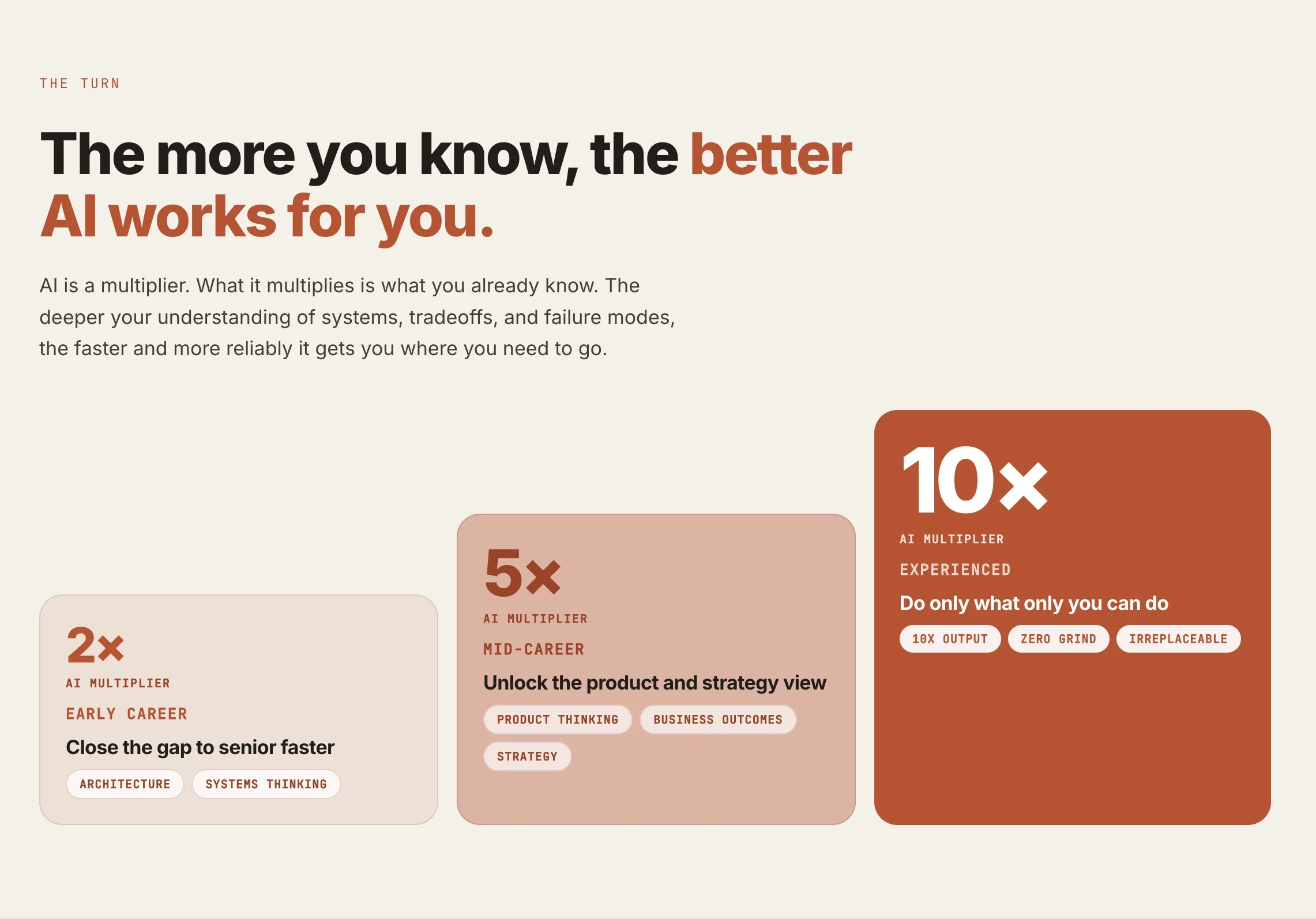
These are not soft skills. They are the result of solving real systems problems for years, and they are exactly what AI tools need to work well.
First principles thinking
When you ask AI to solve a problem, you know how to spot when it is solving the wrong problem. You strip away the framing AI inherited from your prompt and ask what the actual constraint is. Junior developers often accept the AI's framing because they do not have enough experience to recognize when the framing itself is wrong. You restate the problem. Then the AI gives you a useful answer.
Gap analysis
Identifying what is missing requires knowing what should be there. You know which questions to ask: what happens at the edge case, what is the failure mode, what does this code depend on that is not visible in this file, what does the consumer of this API expect that the implementation does not guarantee. AI does not ask these questions unless you do. You know which ones matter.
Pattern recognition
You have seen this before. Different codebase, different language, different year - the same underlying problem. AI generates the solution it was trained on. You recognize when the trained solution does not fit the actual context. That recognition is worth more than the time it saves on code generation, because it prevents work that would have to be undone.
Systems thinking
The code works in isolation. Does it work in the system? What does it do to downstream consumers? What happens when the database is under load? What does the next engineer on this codebase need to understand to not break it accidentally? What are the second-order effects of this design decision? These questions only occur to someone who has seen what happens when they are not asked. You ask them because you have been in the incident call when they were not.
Evaluation capacity
This is the most important one. AI answers confidently. It is right most of the time. But most of the time means there are wrong answers, delivered with the same confidence as the correct ones, that look identical to right answers if you do not know enough to tell the difference. The only thing that catches them is knowing enough to recognize something is off. You have that. Junior developers are still building it, one mistake at a time.
A real example: experience supplying the skepticism, AI supplying the speed
When my team was evaluating the Apache Iceberg sink connector for a production data pipeline, the official documentation claimed upsert capability. A junior developer reading that documentation would likely take it at face value and start building.
I was skeptical. Upsert in a streaming context with schema evolution is hard to implement correctly. I have seen enough claims in documentation that did not survive contact with production to know that "the docs say it works" is not the same as "it works." So instead of starting implementation, I used Claude to analyze the actual source code and test suite.
The analysis found a bug: the upsert feature did not work as documented. The code and tests revealed a specific failure case that the documentation did not mention and that would have caused a data integrity problem in production.
Experience supplied the skepticism: "let me verify this actually works before we commit six weeks of engineering to it." AI supplied the speed: it analyzed thousands of lines of source code and tests in a few minutes. Without the experience, there is no skepticism, no verification, no catching the bug before it hits production. Without the AI, the verification takes days instead of minutes. Together, they caught a problem that would have been expensive.
This is what the advantage looks like in practice. It is not abstract. It is a specific question you knew to ask, answered faster than you could have answered it alone.
How to use this advantage deliberately
The advantage is real, but it is not automatic. You have to direct AI in ways that engage your judgment, not just generate code and accept whatever comes back.
Write the spec before the code. Before asking AI to implement anything, write down what the feature needs to do, what it explicitly should not do, and what constraints it must work within. That two-minute exercise makes you the architect of what the AI builds. Without it, you are reviewing what the AI decided to build, which is a different and weaker role. The spec is where your judgment lives. The AI works inside it.
Ask the follow-up questions you know to ask. After the AI answers, ask: "What could go wrong with this approach?" "What edge cases does this not handle?" "What would a thorough code review say about this?" You know which questions matter for your domain. Ask them explicitly. The AI's answers to good follow-up questions are often more valuable than its initial response.
Verify claims in primary sources. When AI describes how an open source tool works, check the source code and tests, not the documentation. Experience tells you what to be skeptical about. AI tells you what the code actually does. The combination is more reliable than either alone. This is not distrust of AI - it is the same verification instinct you would apply to any claim about software behavior.
What to do now
Pick the next feature or task you are working on. Before opening an AI tool, write two things: what this needs to do, and what it must not do or break. That two-minute exercise puts your judgment at the front of the process rather than the back.
Then use the AI to implement it. Review what comes back with the thinking patterns above: does this handle the edge cases, does it fit the system, would I catch anything wrong here that a junior developer might not. Keep a mental note of the things you catch.
Your experience is the steering wheel. AI is the engine. The engine makes you fast. The steering wheel makes you arrive where you intended.